


CyberChess 2026 brings the international cybersecurity community together in Riga
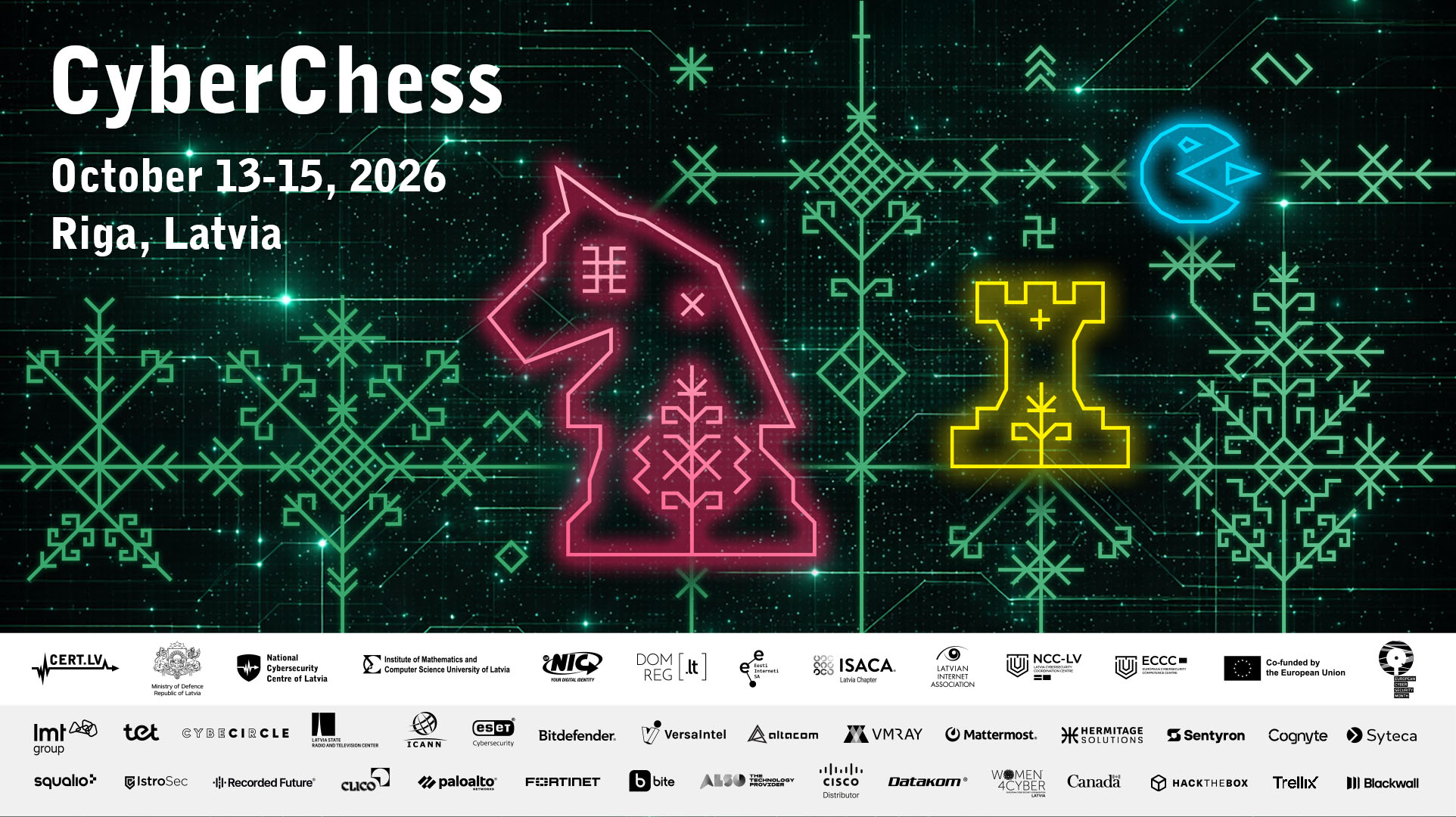
This October, during European Cybersecurity Month, Riga will once again become a meeting point for the Latvian, Baltic and wider international cybersecurity community. On 14-15 October, the international cybersecurity conference "CyberChess 2026" will take place, an event that over more than a decade has grown into one of the key cybersecurity gatherings in the Baltics, neighbouring countries and among Latvia’s allies.
"CyberChess 2026" comes at a time when several high-profile incidents have brought cybersecurity issues into particularly sharp focus in Latvia. The cyberattack against the IT infrastructure of JSC “Latvijas valsts meži” (Latvia’s State Forests), the large-scale data security incident at the Road Traffic Safety Directorate (CSDD), and other events in recent months have demonstrated the importance of organisational preparedness and the ability to respond rapidly to cyber incidents.
“At CyberChess, we discuss cybersecurity not in theory, but in practical terms, looking at the most recent incidents and how they have been addressed. CyberChess brings together IT professionals who will be on the front line of the response when a major cyber incident occurs. In-person participants will also have access to closed sessions where CERT.LV and cybersecurity experts from other countries will share restricted information - technical indicators from incidents that have not been publicly disclosed, observed threat actor tactics and methods, as well as practical technical demonstrations. This is one of the greatest strengths of CyberChess: the opportunity to learn what is simply not discussed elsewhere,” says Dana Ludviga, cybersecurity expert at CERT.LV and member of the CyberChess Programme Committee.
The conference will bring together technical cybersecurity experts, policy and military experts, internet and telecommunications service providers, domain registry representatives and other industry professionals from Latvia and abroad. This year, more than 800 participants from 30 countries will attend CyberChess in person. Registration for in-person attendance has already closed, but everyone is welcome to follow the conference online.
From artificial intelligence to cyber crises and critical infrastructure protection
This year’s conference will focus not only on the cyber threats organisations currently face, but also on how to prepare for them in practice and build resilience in an environment where threats increasingly cross organisational and national borders. The programme will cover the use of artificial intelligence in cyberattacks and AI-powered defence solutions, cyber threat intelligence, vulnerability research and practical cyber defence techniques, cyber-physical systems security, as well as Domain Name System (DNS) security and governance.
The main plenary session will address strategic and policy aspects of cybersecurity at national and European level, while three thematic stages will run in parallel: #CyberStory - featuring real-world experiences and industry developments, #CyberShock - offering in-depth technical presentations and practical demonstrations and #BalticDomainDays - dedicated to DNS security, internet governance and the development of the domain name ecosystem.
Lessons from real-world incidents and a look at what lies ahead
One of the key strengths of CyberChess is bringing together those who shape cybersecurity policy and those on the front lines - experts who analyse attacks, hunt for threats and respond to incidents every day.
At the opening of the conference, Varis Teivāns, Deputy Head and Technical Director of CERT.LV, will examine both prevented and successful cyber incidents, current threats, as well as threat actors’ tactics and interests. He will also highlight the importance of timely incident reporting and active cooperation - both between institutions nationally and with international partners - in preventing and mitigating cyber incidents.
Real-world cyber incidents and the lessons learned from them will take centre stage in the practical experience sessions. Māris Kuzmins from JSC “Latvijas valsts meži” (Latvia’s State Forests), together with a CERT.LV expert, will share their experience of this year’s cyberattack and the subsequent recovery process, while Swiss cybersecurity expert Nadia Meichtry will examine recurring mistakes and patterns observed across cyber incidents affecting different organisations.
A series of technical presentations will focus on the practical application of artificial intelligence in cyber defence. Patrik Hammersborg from the Norwegian National Security Authority (NSM) will explore the use of machine learning to analyse attacker behaviour, while Ernesto Fernández Provecho from the Trellix Advanced Research Center will demonstrate how AI can accelerate threat hunting. Meanwhile, Ampyx News cybersecurity journalist Kerry Tomlinson will draw on a real investigation to reveal how scammers impersonating celebrities use deepfake audio, video and images alongside social engineering techniques.
The programme will also feature several unconventional technical and practical sessions. In his presentation “How to Rob a Bank”, Thomas Tom Freer from OPSWAT will explore the human factor and physical security, while Simon-Pierre Deschênes from Tessellate will examine vulnerabilities in autonomous systems in the context of unmanned aerial vehicles (UAVs). Sébastien Garnault, founder and president of the Paris Cyber Summit, will discuss European cybersecurity in the new geopolitical reality. An international panel featuring experts from NATO, Canada and Europe will also examine cyber crises in which the compromise of a single organisation or critical infrastructure component can trigger cascading effects across national borders.
Ahead of the conference - CTF competition and practical workshops
Ahead of CyberChess 2026, a Capture The Flag (CTF) cybersecurity competition powered by Hack The Box will take place online on 10-11 October. Students, newcomers to the field, as well as local and international cybersecurity professionals will work individually or in teams to identify system vulnerabilities, analyse digital evidence and tackle challenges involving cryptography, web security and other technical areas. The competition provides a safe and controlled environment in which participants can test skills that are also essential for investigating real-world cyber incidents and defending systems.
On 13 October, practical cybersecurity workshops will take place in Riga.
Separate registration is required for the conference, the CTF competition and the practical workshops. Full information on registration for each activity, as well as the conference programme and speaker line-up, is available on the CyberChess 2026 website - https://cyberchess.lv/.
CyberChess 2026 is organized by CERT.LV, the Ministry of Defence of the Republic of Latvia, the National Cybersecurity Centre of Latvia and Top level domain .lv registry NIC.LV in cooperation with ISACA Latvia Chapter, the Latvian Internet Association, the Institute of Mathematics and Computer Sciene University of Latvia and the operators of the .ee (Estonian Internet Foundation) and .lt (DOMREG) top-level domain registries.